You’re Not Bad at Marketing. Your GTM Was Never Built.
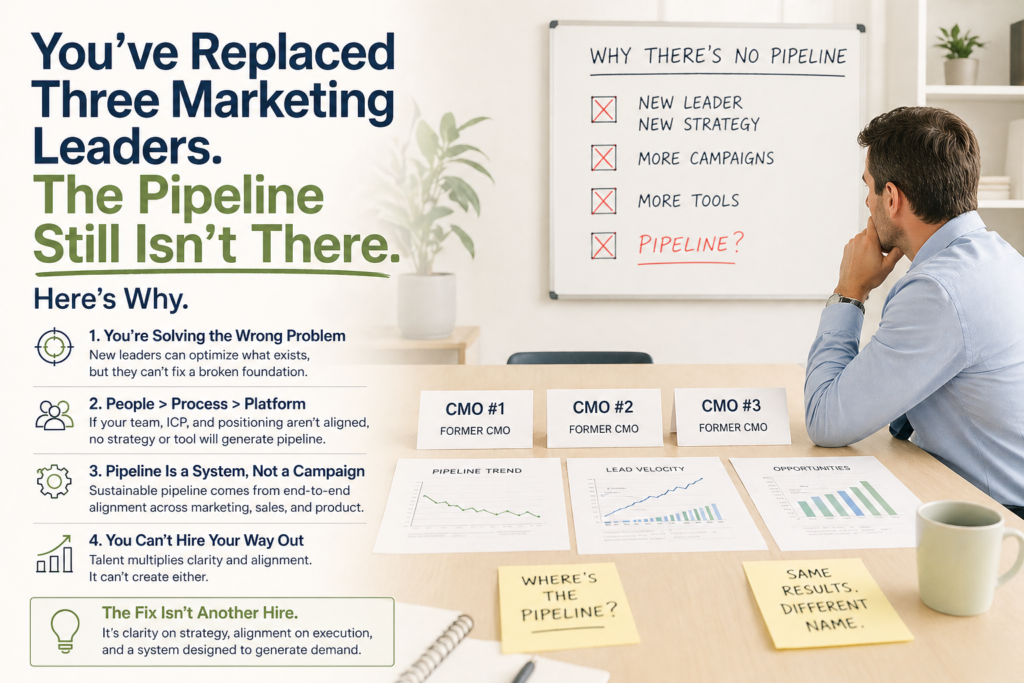
Most companies that struggle with pipeline think it’s a marketing problem. But they have a much older problem — one that was sitting there long before the marketing leader arrived, and one that doesn’t go away when they leave.
There’s a meeting that happens in almost every scaling company. It falls somewhere between month 9 and month 18. The numbers aren’t where they need to be, the board is getting restless, and someone — usually quietly, sometimes not — says the thing everyone was already thinking.
“I don’t think this marketing leader is the right fit.”
So they transition. They search. They hire someone new — stronger resume, fresh mandate, higher salary. And for a little while, things feel like they’re moving again. Then month 9 comes back around.
The sector doesn’t matter. SaaS, fintech, dev tools — this loop shows up everywhere, at roughly the same stage, with roughly the same outcome. And after watching it enough times, one pattern becomes impossible to ignore: the marketing leader was almost never the real problem.
Motion isn’t a System. Scaling motion just makes it more Expensive.
Most early-stage companies have motion. Sometimes strong motion. Deals closing, founders hustling, some channels working. But motion and system are not the same thing — and the difference matters enormously when you try to grow.
A real GTM system means your ICP is defined by actual conversion data — not a hunch. It means sales and marketing are working from the same definition of “qualified.” It means your sales motion doesn’t collapse the moment a founder steps back. It means your messaging doesn’t get rebuilt every quarter.
What most companies actually have is a founder carrying the GTM on their back, a few channels producing inconsistent results, and a CRM that nobody fully trusts. That’s not a marketing execution problem. That’s architecture that was never designed in the first place.
“When you try to scale motion, it doesn’t compound — it just gets louder and more expensive.”
The Hire that’s Mathematically set up to Fail
Here’s where the math quietly stops working.
• 95% of buyers are not in-market at any given time — LinkedIn B2B Institute
• 6–12 months to stabilize a repeatable B2B funnel — SaaStr benchmarks
• 35% of startups fail due to unclear demand or market fit — CB Insights
Most marketing doesn’t convert demand. It builds the conditions for future demand. But the expectation when a first marketing leader starts is pipeline in 90 days, attribution by quarter two, and month-over-month acceleration by end of year.
That’s not a marketing brief. That’s a full GTM rebuild compressed into a single hire — with a performance clock running from day one.
Most companies don’t give it six months before forming a verdict. They give it three.
What a Good First Marketing Leader actually spends their time doing
If the hire is strong, they don’t start with campaigns. They start with the mess nobody cleaned up before they arrived.
That means defining the ICP from real closed-won data — not the whiteboard version from the last offsite. It means getting sales and marketing into a room and forcing them to agree on what “qualified” actually means, which is usually the first time that conversation has ever happened seriously. It means fixing CRM hygiene that’s been broken for two years. It means rewriting messaging that was built on aspiration rather than what buyers actually respond to.
None of this shows up in the pipeline report. But all of it determines whether the next 18 months of growth are repeatable — or just lucky.
“The first marketing leader builds the system while being judged on its output. That’s the job nobody advertises for.”
One Built it. One got Credit for it.
The second CMO almost always looks more effective than the first. Not because they’re the better operator — but because they walk into a functioning system the first person built under pressure, with no baseline and no patience from leadership.
They inherit clean data. Defined funnel stages. A tested messaging baseline. A team that knows how to run. They are optimizing a machine someone else assembled in the dark.
The first person built the machine while being told it should already be producing output. Same scorecard. Completely different starting point.
This is the part that rarely gets said out loud in post-mortems — because saying it out loud means admitting the system failed the person, not the other way around.
Four Questions that Tell You where You Stand
Before replacing a marketing leader — or hiring the next one — these are the only four questions that matter:
1. Is revenue still founder-dependent? If yes, the GTM motion isn’t repeatable yet. That’s not a marketing problem.
2. Can you describe your ICP using actual conversion data? Not intuition. Not “we think mid-market.” Real patterns from deals that actually closed.
3. Do sales and marketing agree on what qualified pipeline means? If they use different definitions in the same meeting, you have a structural problem — not a performance problem.
4. Do you have a repeatable GTM motion — or just activity? Activity can look like traction. A real motion produces consistent, predictable results without founder intervention.
If those four answers aren’t clear and honest, the next marketing hire will land in the exact same position as the last one. They’ll build the system. Get judged on the output. And leave a cleaner operation for whoever comes after them.
That cycle ends when the architecture gets fixed first — not when the right person finally shows up to fix everything else.
Not Sure Where Your GTM Actually Stands?
Take our free 2-minute GTM self-assessment. 10 questions. No fluff. You’ll walk away with a clear readiness score and an honest map of where your system is solid — and where it’s quietly breaking down before it costs you another expensive hire.